
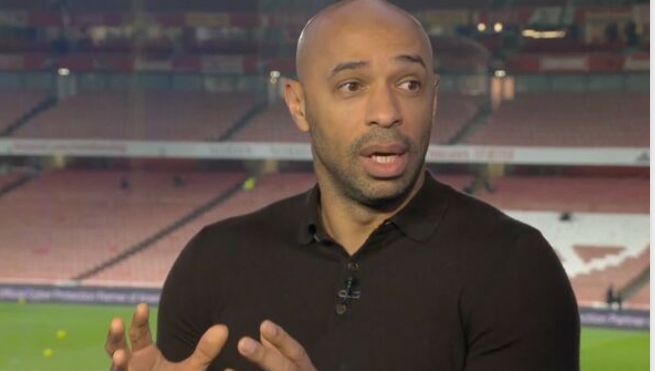
A comfortable 3-1 victory should have left Liverpool supporters in pure celebration mode. Instead, the post-match conversation has been dominated by a brutal assessment from Thierry Henry, who has publicly lost patience with Bradley Barcola. The Arsenal legend refused to let the result disguise what he called a disastrous individual performance from the expensive French winger, questioning how Liverpool could have spent so much money on a player currently delivering so little. “Just because we won comfortably doesn’t mean we should turn a blind eye to what we saw today. I can’t believe Liverpool spent so much on him for performances like this. He’s becoming a waste of resources, and honestly, I’m getting tired of defending him. You cannot be earning that much money and playing this badly,” Henry is reported to have said.
Those words are as cutting as they come. Henry has never been one to soft-pedal criticism, but the language directed at Barcola carries extra weight. “Waste of resources.” “Tired of defending him.” “You cannot be earning that much money and playing this badly.” This is a clear public loss of patience with a player who arrived at Anfield with huge expectations and an even bigger price tag.
The Context: Team Success, Individual Failure
Liverpool’s 3-1 win over Crystal Palace was controlled and professional for long stretches. The scoreline reflected superiority. Goals were scored at the right moments. The three points were never seriously in doubt after the second goal went in. Yet for Bradley Barcola the afternoon was a personal struggle from start to finish.
According to those who watched closely, the Frenchman looked disconnected from the rhythm of the game. His usual explosive first step was missing. Decision-making in the final third was hesitant. Passes that should have been routine went astray. When opportunities arrived to drive at the Palace full-back or combine with teammates in dangerous areas, the execution repeatedly fell short. By full-time the contrast between the team result and Barcola’s contribution was impossible to ignore.
Henry’s central point was simple and uncomfortable. A positive scoreline should not grant automatic protection to underperforming players, especially those who command significant wages and arrived for huge fees. In his view the comfortable nature of the win actually made Barcola’s display more glaring. When the team is functioning and the result is secure, there is even less excuse for a high-profile attacker to drift through the match offering so little threat.
The Weight of the Transfer Fee and Expectations
Bradley Barcola’s move to Liverpool was one of the more eye-catching pieces of business in recent windows. The fee was substantial.
The wages matched the status of a young winger many regarded as one of the most exciting talents in European football. Supporters were told they were getting pace, directness, goal threat and the ability to stretch defences in a way few others could. For a time the early signs were encouraging. There were flashes of the player who had turned heads at his previous club. The problem is that those flashes have become rarer.
Henry’s comments cut directly to the growing disconnect between cost and output. “I can’t believe Liverpool spent so much on him for performances like this.”
The sentence is blunt and devastating. It frames the issue not as a temporary dip but as a developing pattern that is becoming harder to justify. In the ruthless economics of the Premier League, expensive attackers are expected to produce decisive moments on a regular basis. When they do not, the scrutiny intensifies rapidly.
The phrase “waste of resources” will particularly sting. Clubs work within finite budgets. Heavy investment in one player means less flexibility elsewhere. When that player fails to deliver consistent impact, the opportunity cost becomes a live talking point among supporters and pundits alike. Henry, who carried the burden of massive expectations throughout his own career, clearly believes Barcola is currently falling well short of the required return.
“I’m Getting Tired of Defending Him”
The most personal element of Henry’s assessment is the admission that his own patience has run out. “I’m getting tired of defending him.” That line suggests the Frenchman has previously looked for mitigating factors — adaptation to a new league, tactical unfamiliarity, the challenge of replacing established wide options. Those arguments appear to have reached their limit.
Elite wages demand elite standards. When a player of Barcola’s profile and salary produces the kind of anonymous display seen against Crystal Palace, the disparity becomes impossible to ignore. Henry is effectively stating that the benefit of the doubt has been exhausted. The talent that convinced Liverpool to invest heavily is still somewhere inside the player, but it is being obscured by inconsistency, poor decision-making and a lack of decisive end product.
There is also a wider point about accountability. Winning teams can sometimes allow individual mediocrity to hide in plain sight. A 3-1 scoreline creates a feel-good atmosphere that softens criticism. Henry is determined not to let that happen with Barcola. His message is that standards must be upheld regardless of the result, and right now those standards are not being met.
Detailed Breakdown of a Difficult Afternoon
From the opening exchanges Barcola struggled to impose himself. Palace’s defensive shape limited the spaces he likes to attack, and he found little joy in one-versus-one situations. Attempts to drop deeper and link play often resulted in lost possession. When Liverpool broke at speed, the final ball or the shot that should have tested the goalkeeper failed to materialise. Defensively he was also caught out of position on more than one occasion, forcing teammates to cover extra ground.
By the second half the frustration was visible. Touches became heavier. Body language grew tighter. The usual confidence that allows him to take risks and drive at defenders seemed to desert him. Even when the game was stretched and opportunities for counter-attacks appeared, Barcola was not the player driving them. In a match Liverpool controlled for long periods, his influence remained minimal.
That lack of impact is what triggered Henry’s strongest criticism. For a winger signed to provide width, vertical threat and goal contributions, an afternoon this quiet is difficult to defend — especially when the team is winning comfortably and the platform is there to shine.
Fan and Media Reaction: A Growing Divide
As Henry’s comments circulated, Liverpool supporters split into familiar camps. One section welcomed the honesty, arguing that big fees and big wages must be matched by big performances and that no player should be shielded by a positive scoreline. Another section felt the criticism was excessive for a single poor game and pointed to Barcola’s age, potential and previous brighter moments.
Social media reflected the tension. Some posts repeated Henry’s strongest lines and called for the Frenchman to be removed from the starting eleven until form returns. Others accused the pundit of piling on and reminded everyone that young attackers often need time and confidence.
The debate itself underlines how high the stakes have become. When an Arsenal legend’s verdict can dominate discussion after a convincing Liverpool win, the pressure on Bradley Barcola has clearly reached a new level.
Other voices in the media have begun to echo elements of Henry’s assessment. While few have gone quite as far as “waste of resources,” there is a growing consensus that Barcola’s output this season has not yet matched the investment. The talent is obvious on his best days. The problem is that those best days have been too infrequent.
The Bigger Picture for Liverpool and Barcola
Beyond the individual, Henry’s intervention raises questions about squad management and the management of high-cost assets. Liverpool’s coaching staff will be aware of the noise. While one pundit’s opinion does not dictate selection, sustained underperformance from an expensive attacker eventually forces decisions about minutes, role and even long-term planning.
The club’s strong overall position provides some protection. Positive results make it easier to be patient with developing players. But football moves quickly. A sequence of tougher fixtures or a drop in team form would intensify the spotlight on any underperforming high earners. Henry’s comments may prove to be an early warning rather than a one-off outburst.
For Barcola the path forward is clear if unforgiving. Performances must improve, and quickly. The explosive qualities that made him such an attractive target have not vanished, but they are currently being masked by hesitation and a lack of end product. Only a sustained run of direct, decisive displays will quiet the growing doubts.
Looking Ahead: The Pressure Intensifies
The coming weeks will be revealing. Every touch, every decision, every moment on the ball will be examined more closely than before. Henry has set a tone. Other pundits may now feel freer to speak critically. Barcola will need significant mental strength to block out the noise and focus on the next opportunity to prove his worth.
Liverpool’s coaches face their own choices. Continue to show faith in the hope that confidence returns, or reduce playing time until the required levels reappear. Both options carry risk. Persisting with a struggling player can frustrate the fanbase and affect team balance. Removing him can damage confidence further and leave the attack short of options.
What is already certain is that the free pass has expired. A 3-1 win delivers three points and temporary breathing space for the team, but it no longer provides cover for every individual. Thierry Henry has made sure of that in the most public way possible.
His message was blunt, uncomfortable and impossible to ignore. Liverpool invested heavily in Bradley Barcola. The performances are not matching that investment. And one of the sharpest minds in the game is tired of making excuses.
The French winger has been put on notice. How he responds in the matches ahead will shape the next chapter of his Anfield career. For now, a comfortable team victory has been overshadowed by a very uncomfortable individual conversation.
HENRY HAS SPOKEN. BARCOLA IS UNDER THE MICROSCOPE. THE NEXT PERFORMANCE WILL BE SCRUTINISED LIKE NEVER BEFORE.
Leave a Reply