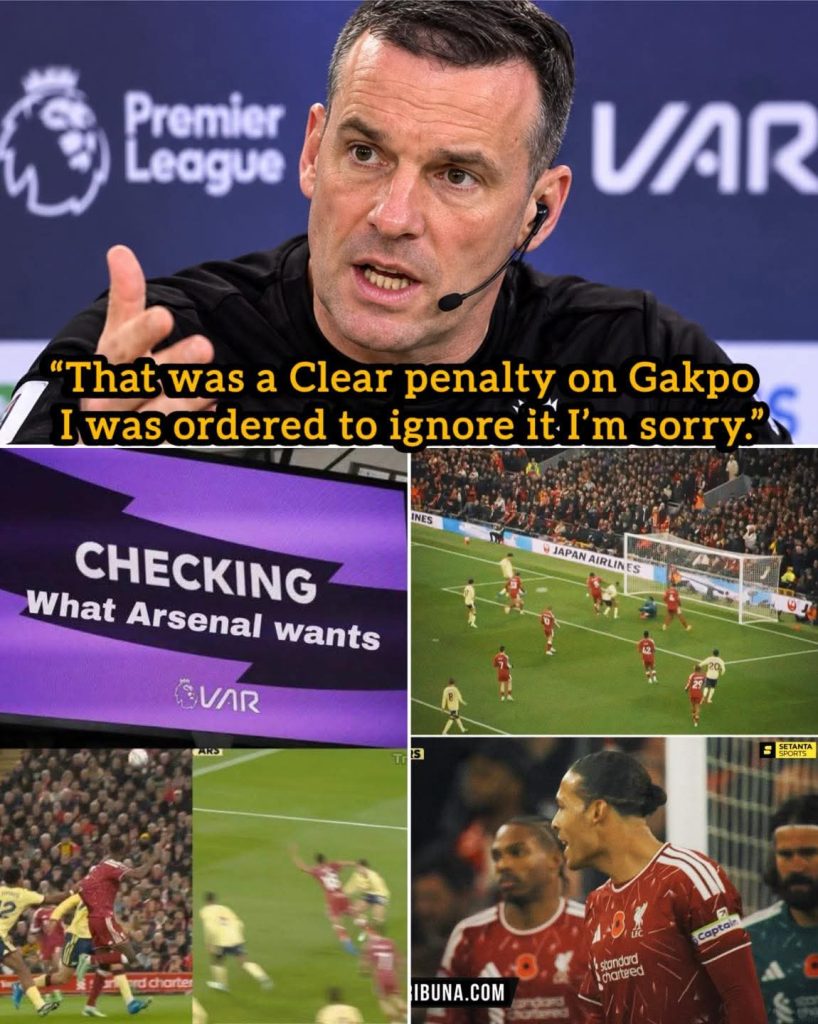

Liverpool’s controversial defeat to Arsenal has taken another dramatic turn following the disputed penalty appeal involving Cody Gakpo and Arsenal winger Christos Tzolis.
The incident has generated widespread discussion, with supporters questioning why referee Andy Madley rejected Liverpool’s appeals despite clear physical contact inside the penalty area.
A viral statement circulating online now claims Madley privately disagreed with the decision and was instructed by higher authorities not to award Liverpool a penalty.
The alleged comments have created an even bigger controversy, with the referee supposedly insisting that Gakpo’s natural movement was prevented by the Arsenal player’s hands.
However, there is currently no credible confirmation that Madley made those comments or claimed that anyone instructed him to ignore the incident.
Nevertheless, the original decision deserves closer examination.
THE INCIDENT THAT LEFT LIVERPOOL DEMANDING A PENALTY
The controversy occurred in the 29th minute at Anfield.
Liverpool were searching for an equaliser after Kai Havertz had given Arsenal the lead in the 16th minute.
Alexis Mac Allister delivered a lofted pass towards Gakpo, who attempted to reach the ball inside Arsenal’s penalty area.
However, Christos Tzolis made contact with the Liverpool forward, placing his hands around Gakpo’s thighs as the Dutchman went to ground.
Liverpool’s players immediately appealed for a penalty.
Madley was not convinced and waved away the protests.
VAR subsequently reviewed the incident but supported the referee’s original decision.
The decision immediately divided opinion.
Liverpool supporters believed the contact was sufficient to justify a penalty, while others questioned whether Gakpo would have reached the ball even without the challenge.
WHY GARY NEVILLE DEFENDED THE DECISION
Former Manchester United defender Gary Neville offered a different interpretation of the incident.
Neville acknowledged that Tzolis’ challenge was clumsy and reckless, but argued that Gakpo was unlikely to reach the ball because an Arsenal defender was already ahead of him.
His assessment was that the contact did not justify awarding a penalty.
That argument has become central to the debate.
Under football’s Laws of the Game, physical contact inside the penalty area does not automatically constitute a foul. The referee must determine whether the challenge was careless, reckless or otherwise punishable.
The question is whether Tzolis’ actions unfairly prevented Gakpo from continuing his movement towards the ball.
WAS ANDY MADLEY OVERRULED BY VAR?
This is where the viral allegation becomes particularly interesting.
The circulating statement claims Madley believed the incident was a clear penalty but was instructed by higher authorities to maintain his original decision.
However, no authenticated interview, official referee recording or credible report has established that this happened.
The available match reporting confirms that Madley waved away the appeal and VAR supported his decision.
It is also important to understand that VAR officials are not supposed to make decisions based on pressure from outside authorities.
Their responsibility is to review incidents under the established protocol and intervene when the relevant threshold for a clear and obvious error or serious missed incident is met.
The referee remains responsible for the final on-field decision.
Consequently, claims that Madley was ordered to ignore a penalty should not be treated as established fact.
LIVERPOOL HAD ANOTHER PENALTY APPEAL INVOLVING ALEXANDER ISAK
The Gakpo incident was not the only moment that left Liverpool frustrated.
Earlier in the match, Alexander Isak appeared to have his shirt pulled by Jurriën Timber inside Arsenal’s penalty area.
Liverpool appealed, but neither Madley nor VAR awarded a penalty.
That decision attracted particularly strong criticism from former Liverpool striker Daniel Sturridge, who described the shirt-pulling as clear and blatant during Sky Sports’ analysis.
Former Arsenal striker Ian Wright also acknowledged that his former club had benefited from the decision.
Jamie Carragher questioned why Isak needed to exaggerate the contact before officials would consider awarding a penalty.
The two incidents have therefore become separate talking points in the aftermath of Arsenal’s victory.
ARSENAL LEAVE ANFIELD WITH THREE POINTS
While Liverpool continue debating the officiating, Arsenal have already secured the result.
Havertz’s first-half goal proved decisive, giving Mikel Arteta’s side a valuable 1–0 victory.
Liverpool created opportunities, with Florian Wirtz striking the crossbar, but Arsenal defended resolutely and prevented the home side from finding an equaliser.
The defeat ended Liverpool’s five-match winning streak and left Iraola facing questions about his team’s performance.
For Arsenal, it was a significant result in the Premier League title race.
THE BIGGER QUESTION FOR THE PREMIER LEAGUE
The controversy highlights a problem that continues to frustrate football supporters: the lack of universal agreement over what constitutes a clear penalty.
VAR was introduced to help officials correct major mistakes, but controversial decisions continue to generate arguments long after matches finish.
Liverpool supporters will naturally want an explanation of why the Gakpo incident was considered insufficient for a penalty.
The Timber shirt-pull will also remain under scrutiny.
However, until Madley makes an authenticated public statement, claims that he risked his career by exposing pressure from higher authorities remain unverified.
One thing is certain: the two penalty appeals have ensured that Arsenal’s victory will continue to generate discussion.
Leave a Reply