
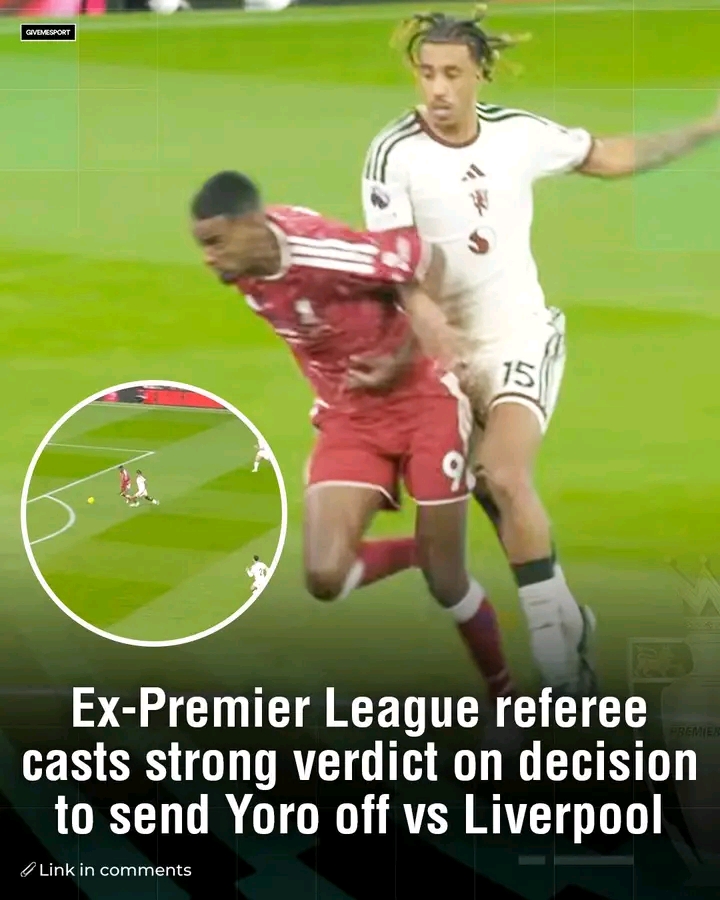
Things did not go according to plan for Mauricio Pochettino in his first game as Manchester United manager.The former Tottenham and Chelsea boss was given one of the toughest tasks of all in his first game in charge, a trip to old rivals Liverpool at Anfield and almost from the outset it was an absolute nightmare for a manager tasked with revolutionising Manchester United.
Eight minutes in, United were reduced to ten men, with Leny Yoro sent off for a clumsy tackle on Alexander Isak as he went through on goal. And then, within five minutes, United were 2-0 down with Dominik Szoboszlai scoring the resulting free-kick and Florian Wirtz volleying home from a Rio Ngumoha cutback.
Ngumoha himself scored in the second half, with substitute Victor Munoz rounding off the route with a fourth late on.The red card was the big talking point in the match, with questions raised as to whether it reached the threshold for the denial of a golascoring opportunity.
Former Premier League referee Graham Barber thought the right decision was made.Speaking exclusively, he said: “I think it was a red card.”I think everybody in the stadium and most pundits and when I first saw it, I thought it was a red card. and I thought it was, in fact, quite an easy decision.”The discussion has been around the four points that need to be met for it to be considered the denial of a goalscoring opportunity.
Four DOGSO considerations:Distance between the offence and the goal: How close the incident is to goal, and whether a shot or scoring chance is realistic.General direction of play:
Whether the play is moving toward the goal rather than away from it or sideways.Likelihood of keeping or gaining control of the ball: How likely the attacker is to control or reach the ball (for example, when a bouncing ball is in front of them).Location and number of defenders (and attackers): How many covering defenders are between the attacker and the goal, where they are positioned, and the presence/positions of other attackers.
Three of those considerations were clearly met, but the question is, did Isak have control of the ball when he was bearing down on goal? Manchester United goalkeeper Senne Lammens was quick off his line and pounced on the ball soon after Iask was brought dow, leading to suggestions Isak would not have got on to his errant touch.Barber disagreed. He added:
“The consideration that the referee has to make, he probably has to make these decisions in a millisecond, so I think people need to understand how quickly that has to be computed through his head.”The distance between the offence and the goal is one of the things he has to consider. He obviously looks at the general direction of play, and then also whether there are the defenders around him or not, but the one that comes into question is the likelihood of Isak winning the ball.”Who is to say whether Isak would have got the ball or not?
He was running at pace, at real pace at that time. Can you overturn a red card based on that? Highly unlikely, and that’s why I don’t think VAR was brought into the case because no one will ever know unless a red card was never issued, if the foul was never committed, if he would have got onto the ball.”In that instance alone, with that particular part of the law, I think the decision was correct.”
Leave a Reply